
Mechanical design engineers planning a drive train typically have a range of component options to choose from, and many decisions will boil down to the specific application. When it comes to creating optimal torque output, rotational speed and direction, few decisions are as important in designing high performing gear drives as choosing the right gear for the job.
Jump to a Section
Helical Gear vs. Spur Gear: What’s the Difference & Which is Better?
With so many products, applications and requirements out there, several different gear types have been developed to handle specific jobs correctly. For most basic and common applications of gears sets, the options are most often focused on two specific types, which we’ll contrast here: spur gears vs. helical gears.
We can’t hope to cover every scenario or evaluate how different configurations may weigh into a choice between a helical gear and a spur gear in this article. Focusing on some of the most general requirements will help guide a decision; we’ll make comparisons between these two gear options on these seven general performance considerations:
- Power transmission efficiency - the amount of speed to be transferred without waste or producing added forces
- Load bearing capacity - the torque production and accommodation between the drive shaft and reduction gears
- Speed handling - byproduct of efficiency and load bearing capacity, speed of movement the gear can handle
- Durability requirement - expected lifetime of the gear, bending strength, scoring resistance and surface durability
- Vibration & noise limits - the level gear mesh smoothness required in the final product
- Cost to manufacture & maintain - the complexity to produce the gear and their relative availability
- Capabilities - the mechanical function of the gear in relation to the gear set
Other Considerations When Choosing a Gear
The above criteria can be used to help choose between a standard spur and helical spur gear, but there are a number of other factors to consider before making the ultimate choice. They are more granular and situationally dependent, and will greatly affect the gears performance in a specific application. These include:
- Partition type
- Number of teeth
- Circular pitch
- Pitch circle
- Pitch diameter
- Size
The Basics of Helical Gears & Spur Gears
Let's dig into some of the basic characteristics of helical gears and spur gears:

When people picture a mechanical gear in their head, they’re often thinking first about a spur gear. This is for good reason: spur gears are the simplest type of gear available, consisting of a disk or cylinder with teeth projecting radially from the axis. The teeth of a spur gear are straight cut and at a parallel angle to the axis of rotation.
Configurations where standard spur gears are incorporated include:
Spur Gear Mechanical Capabilities
- Increase speed
- Reduce speed
SUMMARY: Benefits of Spur Gears
Spur gears are simple to produce, offer high efficiency of power transfer with less wasted axial force and are available in perhaps the widest range of shapes, sizes and materials. They don’t produce as much friction and tend to wear more slowly. Along with their wide availability, they are a cost-effective choice as long as high-speed performance and smoothness is not required.
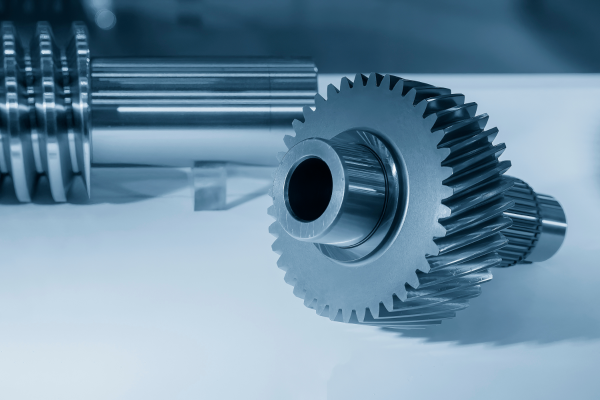
Helical gears are a subset of spur gear types. Similar to a spur gear, their teeth radiate away from the axis of rotation, and they’re most often made up of a disc or cylinder. However, their key difference from spur gears is the angle their teeth are cut along the gear’s face, which is not parallel to the drive shaft axis (usually 12-20 degrees). Helical gear sets are typically mounted between parallel axes, but their angled teeth allow certain types to also accommodate non-parallel axes, adding versatility that standard spur gear sets can’t offer.
Importantly, from a performance standpoint, the gear’s slanted tooth trace allows a helical gear to mesh more gradually with a properly aligned gear. As the two gears teeth slide into each other, they benefit from longer time in contact which provides more efficient power transmission. This makes helical gears well-suited for higher speeds and loads.
Helical Gear Mechanical Capabilities
- Increase speed
- Reduce speed
- Change shaft direction
Helical Gear Types
- Parallel-axis - most common type, transmits power between mating gears on parallel shafts
- Crossed-axis - these types can be paired with mating gears set on perpendicular shafts
- Double helical (“herringbone gear”) - these have opposite-handed teeth angles split midway on the gear’s face. Can be used to mitigate axial thrust loads present in parallel-axis configurations.
SUMMARY: Benefits of Helical Gears
The greatest advantages of helical gear types are in their ability to handle bigger loads and higher speeds with less noise and vibration than a standard helical gear. For these reasons, they find use in everything from small precise equipment to large industrial machinery.
The main design characteristic of a helical gear is also what provides its advantages: the angle of the cut of their teeth. This angle allows for prolonged duration of contact between driving and driven gears compared to a standard spur gear and meshes more teeth at any given point relative to other spur gear types. The helical gear’s contact ratio (representing the number of teeth on each gear connecting when any gear set is in mesh) is typically higher than that of a spur gear, which lends to added strength because the load is dispersed among more teeth.
Axial Thrust’s Effect on Efficiency
The angled teeth of a helical gear creates a unique axial thrust force that doesn’t occur with standard spur gears. This tends to push helical gears in directions perpendicular to the tooth’s surface, resulting in some loss of efficiency. Engineers should incorporate thrust bearings or consider other types of helical gears - double helical, for example - to offset this force.
With so many applications and variations, the correct choice between a helical or spur gear is not always straightforward. Where the helix angle of a helical spur gear may offer benefits unavailable to a standard spur gear, the helical gear may be a needlessly complicated solution or may be incompatible with a gear train configuration. The following comparisons assume equal gear width, size and material composition under optimal alignments and lubrication (if required).
Power Transmission Efficiency Comparison
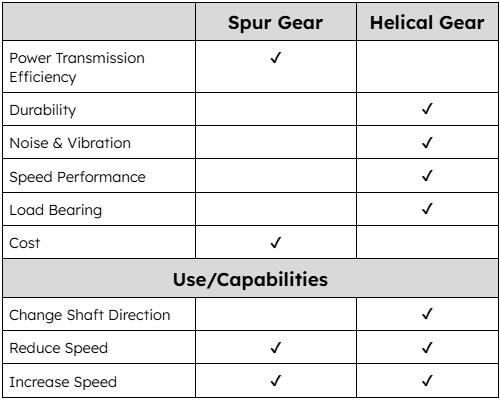
Spur gears are more efficient in transmitting power because they produce no axial thrust.
Durability Comparison
Helical gears provide more teeth contact during gear mesh, distributing the load and reducing overall wear. However, they produce additional axial thrust due to their teeth angle, creating a sliding action and added friction not found in spur gears. This can be mitigated through use of a bearing or herringbone helical gear type.
Noise & Vibration Comparison
Helical gears’ angled teeth interact with rotational axes at oblique angles for more gradual engagement, lowering vibration and noise generation.
Speed Performance Comparison
Helical gears’ angled teeth lend smoother operation and higher load-bearing capability resulting in higher torque transferral and can typically handle higher drive speeds.
Load Bearing Comparison
Helical gears’ angled teeth create more surface area and contact between gears and drives, which typically supports higher load bearing.
Cost of Manufacture & Operation Comparison
Spur gears are simpler and less expensive to produce. They also generate less wear, reducing the frequency of replacement.
Contact Ratio Comparison
Helical gears typically provide a higher contact ratio than spur gears. This is due to the additional axial contact ratio resulting from their angled teeth, keeping more teeth in contact at the mesh point for a longer duration. Spur gear operation results in “single tooth loading” which means most of the load is borne by one tooth at a time (two teeth may be in contact during a cycle, albeit briefly). These differences mean spur gear contact ratios range from 1.2 - 1.6 , while helical gears can be designed with contact ratios in excess of 2, meaning they could qualify as high-contact ratio gears.
Going Beyond Comparison: WM Berg Answers Your Gear Questions
Understanding basic differences in gear types is only a baseline for getting the most out of gear systems in precision gear applications. Our team of engineers and designers offer detailed product support and technical recommendations to optimize gear sets, whether you need a standard straight cut spur gear or a custom herringbone helical cut gear. Our team will dig deep into the details to find the most efficient and cost-effective component for your needs.