A universal joint is a mechanism with a bendable rotation axis that allows transmission of torque or rotational motion between a pair (or more) of drive shafts. The key feature of universal joint couplings is the ability to transmit these forces between two points that are not in direct alignment with each other.
Basic Components of a Universal Joint
The defining mechanisms allowing this offset connection are a pair of hinged couplings at the ends of a drive shaft and a driven shaft (or output shaft), which are oriented at 90° to each other and are connected by a cross shaft. The cross shaft rotates at the same rate as the drive shaft, but it also spins on its axis to accommodate non-aligned drive and output shafts.
Straight vs. Angled Connection: Different Output Speeds
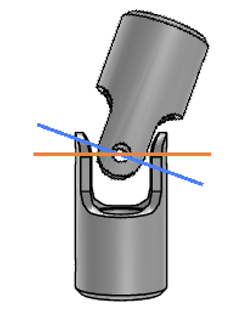
When the two shafts are aligned straight, there is a constant 1:1 turn ratio between the two shafts. If the paired shafts are not aligned, as in many cases with universal joint applications, the output shaft experiences a fluctuating amount of rotation, resulting in a variable speed. The variation of speed is proportional to the degree of the angle of the drive and output shafts.
Inclined Axes
This fluctuation is due to the additional motion the cross shaft experiences as power is transmitted from a driving shaft to an angled driven shaft. As the input shaft rotates, the force required to rotate the output shaft creates an oscillating forward then backward spin of the cross shaft along its axis connected to the driving shaft. This creates non-uniform rotational speeds in the driven shaft.
For the first 90° of the cross shaft’s forward spin, there is a steady amount of angular displacement of the output shaft. As the driving shaft continues to rotate, the spin of the cross joint quickly reverses direction, which translates in a temporary and repeating drop in rotational torque and a difference in output speed.
Double Universal Joint: The Solution to Speed Variation
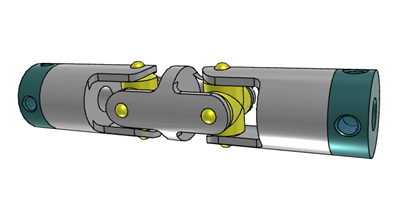
When an equal turn ratio is needed but the two shafts are not in alignment, a double universal joint (or double Cardan joint) should be used.
A double universal joint has a pair of crosses, each connecting to an end of the drive shaft and the driven shaft. As long as the two joining angles are equal, the oscillating effect of the inclined axes is effectively cancelled out and velocity will be constant.
While single universal joints can handle up to 45° angle differences between the input and output shafts, a double universal joint can accommodate higher operating angles of up to 90°.
Looking for a Universal Joint? Berg Can Help!
Our team of mechanical engineers can help you find the right universal joint coupling to fit the precise needs of your application. We can also supply custom-made universal joints in case our stock products do not fit the bill. Contact one of our engineers today to learn more.